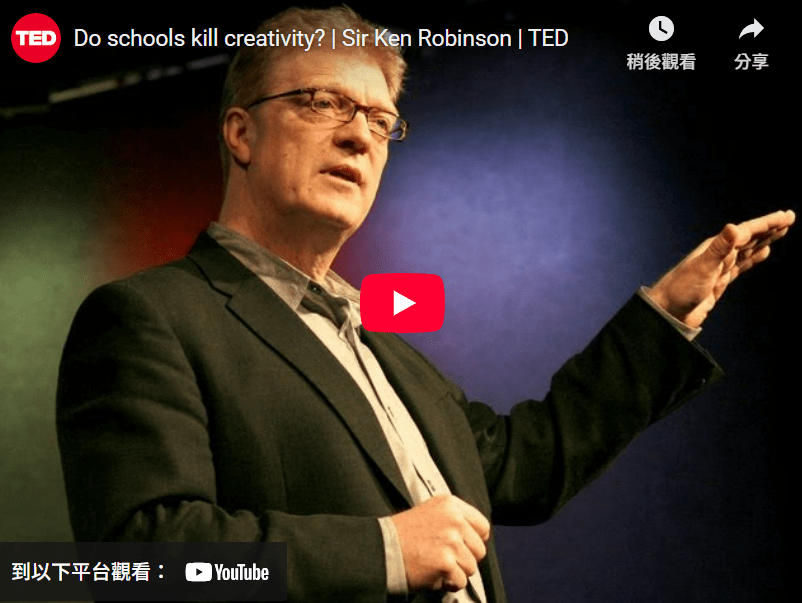
學校扼殺了創意嗎?
Sir Ken Robinson • TED2006
Link: https://www.youtube.com/watch?v=iG9CE55wbtY
解析:
This appears to be the transcript of Sir Ken Robinson’s famous TED Talk, “Do Schools Kill Creativity?" delivered in 2006. In this talk, he explores three themes:
1. The extraordinary evidence of human creativity presented at the conference and its relevance to education.
2. The unpredictability of the future and the challenge it poses for education systems that aim to prepare children for a world they cannot yet imagine.
3. The remarkable capacities of children for innovation, which are often stifled by our educational systems.
Sir Ken Robinson argues that creativity is as important in education as literacy and should be treated with the same status. He uses several examples from his personal life, including stories about his son’s experiences at school and his own observations about the way we educate children.
He highlights the problem of “academic inflation" where degrees become less valuable over time, and the need to rethink our view of intelligence as being diverse, dynamic, and distinct. He also shares a powerful story about Jillian Lynn, a choreographer who was told she had a learning disorder at school but went on to have a successful career.
Throughout his talk, Sir Ken Robinson emphasizes the importance of valuing creativity and imagination in education, and the need for a new conception of human ecology that recognizes the richness of human capacity. He concludes by saying that our task is to educate children’s whole being so they can face an uncertain future with hope and creative potential.
The final section of the transcript appears to be a departure from Sir Ken Robinson’s main talk, as it refers to a different topic or theme (the importance of artistic vision in design) but still captures his enthusiasm for creativity and innovation.
中譯:
這似乎是肯·羅賓遜爵士著名的 TED 演講“學校扼殺創造力嗎?”的記錄。於 2006 年發表。在本次演講中,他探討了三個主題:
1. 會議上提出的人類創造力的非凡證據及其與教育的相關性。
2. 未來的不可預測性及其對教育體系所提出的挑戰,教育體系旨在幫助孩子為他們尚無法想像的世界做好準備。
3. 兒童具有非凡的創新能力,但我們的教育體係常常抑制這種能力。
肯·羅賓遜爵士認為,創造力在教育中與讀寫能力同樣重要,應該享有同等地位。他舉了幾個個人生活中的例子,包括他兒子在學校的經歷以及他自己對我們教育孩子方式的觀察。
他強調了「學術通貨膨脹」的問題,即學位隨著時間的推移變得越來越不值錢,並強調我們需要重新思考智力的多樣性、動態性和獨特性。他還分享了一個關於編舞家吉莉安·林恩的感人故事,她曾在學校被告知患有學習障礙,但後來卻取得了成功的職業生涯。
在整個演講中,肯·羅賓遜爵士強調了在教育中重視創造力和想像力的重要性,以及需要一種新的人類生態學概念來認識到人類能力的豐富性。他最後說,我們的任務是教育孩子的全面發展,以便他們能夠充滿希望和創造潛力地面對不確定的未來。
演講稿的最後一部分似乎與肯·羅賓遜爵士的主要演講有所不同,因為它涉及不同的主題或主題(藝術視野在設計中的重要性),但仍然體現了他對創造力和創新的熱情。

 Almoon Studio
發表留言